
As African nations gained independence from colonial rule in the late twentieth century, a powerful promise emerged: Africa would finally chart its own destiny.
More than six decades later, Africa has received trillions of dollars in aid, loans, and development investments. The continent has hosted more development programmes, pilot projects, and humanitarian interventions than perhaps any other region on earth aimed at reducing poverty, improving health outcomes, expanding education, and accelerating economic growth. Yet despite undeniable progress, one uncomfortable reality remains: too many development interventions struggle to deliver lasting change once external funding ends. This raises some important questions:
Has Africa truly gained ownership of its development agenda?
Who should define Africa’s development agenda and why?
The answers matter because there is a profound difference between a community that receives a solution and one that helps create it. The first fosters dependency, the second creates ownership, resilience, and transformation, and for too long, too much of what has been called “African development” has been dependency dressed up as transformation.
The Continent That Will Define the Next Century
By 2050, Africa’s population is projected to reach approximately 2.5 billion, meaning one in every four people on earth will be African. Nigeria alone is projected to become the world’s third most populous nation after China and India.
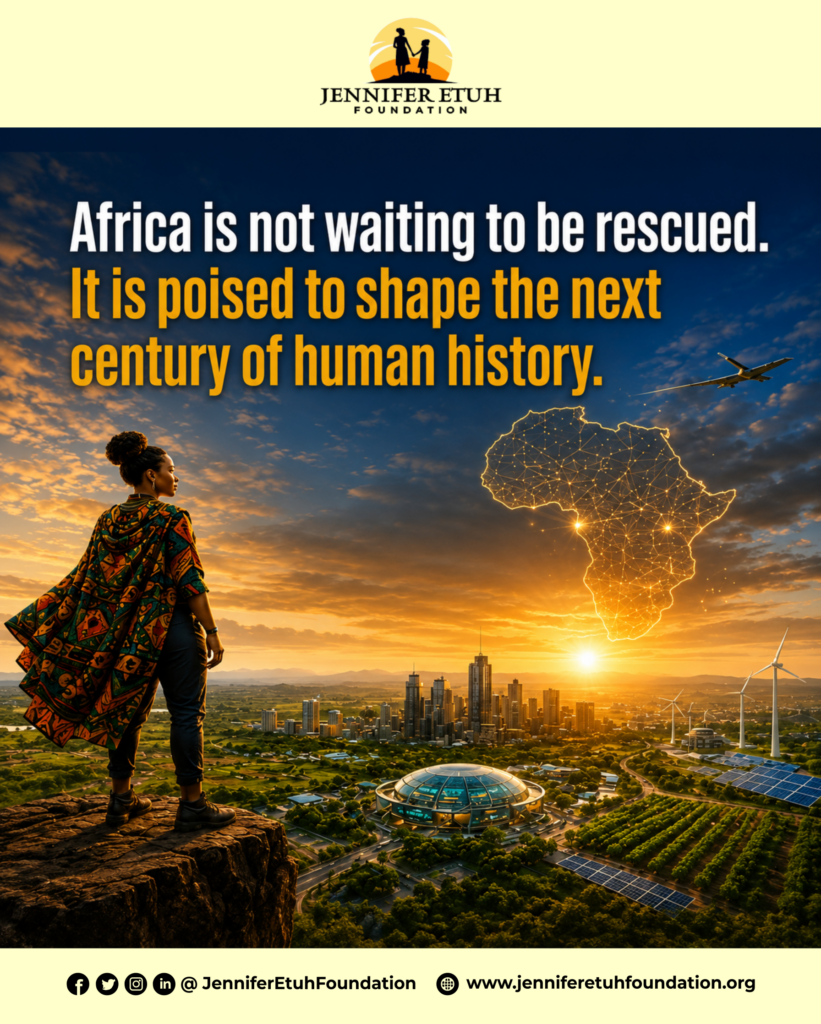
Africa already holds 65% of the world’s uncultivated arable land, the youngest workforce on earth, and some of the fastest-growing economies globally. This goes to show that Africa is not a continent waiting to be rescued; it is a continent poised to shape the next century of human history. So, the question is not whether Africa will matter; the question is whether Africa will lead its own story.
As African nations gained independence from colonial rule in the late twentieth century, a powerful promise emerged: Africa would finally chart its own destiny.
More than six decades later, Africa has received trillions of dollars in aid, loans, and development investments. The continent has hosted more development programmes, pilot projects, and humanitarian interventions than perhaps any other region on earth aimed at reducing poverty, improving health outcomes, expanding education, and accelerating economic growth. Yet despite undeniable progress, one uncomfortable reality remains: too many development interventions struggle to deliver lasting change once external funding ends. This raises some important questions:
Has Africa truly gained ownership of its development agenda?
Who should define Africa’s development agenda and why?
The answers matter because there is a profound difference between a community that receives a solution and one that helps create it. The first fosters dependency, the second creates ownership, resilience, and transformation, and for too long, too much of what has been called “African development” has been dependency dressed up as transformation.
The Continent That Will Define the Next Century
By 2050, Africa’s population is projected to reach approximately 2.5 billion, meaning one in every four people on earth will be African. Nigeria alone is projected to become the world’s third most populous nation after China and India.
Africa already holds 65% of the world’s uncultivated arable land, the youngest workforce on earth, and some of the fastest-growing economies globally. This goes to show that Africa is not a continent waiting to be rescued; it is a continent poised to shape the next century of human history. So, the question is not whether Africa will matter; the question is whether Africa will lead its own story.
The Development Paradox: Investment Without Transformation
Africa is not short on ideas, talent, innovation, or resilience. It’s most effective development actors; community health workers in rural Nigeria, agritech innovators in Kenya, smallholder farmer cooperatives and social entrepreneurs in Ghana, and youth-led civic movements across the Sahel, solve problems every day. Yet development frameworks are often designed externally, implemented locally, and measured using indicators that may not fully reflect local realities. This poses a major challenge and calls the broader development ecosystem to stop treating local actors as implementers and start recognising them as architects.
What’s Holding Back the Shift?
Research on community-driven development consistently reveals that when communities identify their own needs, design solutions, make resource decisions, and hold implementers accountable, they outperform top-down programmes on long-term sustainability metrics. Not because local is always better, but because people protect what they build, sustain what they own, and trust solutions they helped design.
Since the evidence is so compelling, why has the shift toward locally-led development been so slow? Three structural barriers continue to stand in the way.

#1: Donor Conditionality: Funding often comes with rigid requirements around reporting, procurement, audits, and programme design. While accountability is essential, these conditions can reduce local organisations to subcontractors rather than strategic leaders.
#2: Risk Aversion: Local organisations are frequently perceived as higher-risk partners due to concerns about capacity and compliance. While capacity gaps may exist, the solution is not to withhold leadership opportunities but to invest in stronger systems, governance, and institutional development.
#3: Misaligned Incentives: Development is an industry where international NGOs and local organisations often compete for the same funding, but not on equal terms. Creating meaningful change requires donors to intentionally fund local actors, strengthen their capacity, and share decision-making authority, not merely implementation responsibilities.
Beyond Projects: Building Systems That Last
One of the greatest weaknesses in development practice is an overemphasis on projects at the expense of systems. Consider the contrast: a free medical outreach that treats thousands of patients in a week, providing access to healthcare for a senior citizen who had no other way of accessing care, diagnosis for the mother in dire need, treatment for a child’s illness that was left unattended for months, distribution of mosquito nets, and training of health workers can provide immediate relief and reduce malaria rates significantly. However, a programme that does the same, and strengthens the primary healthcare system with proper funding, staffing, governance, and capacity to procure, distribute, and monitor those nets independently, can improve the health outcomes of an entire region for generations because projects have timelines, but systems build legacies.
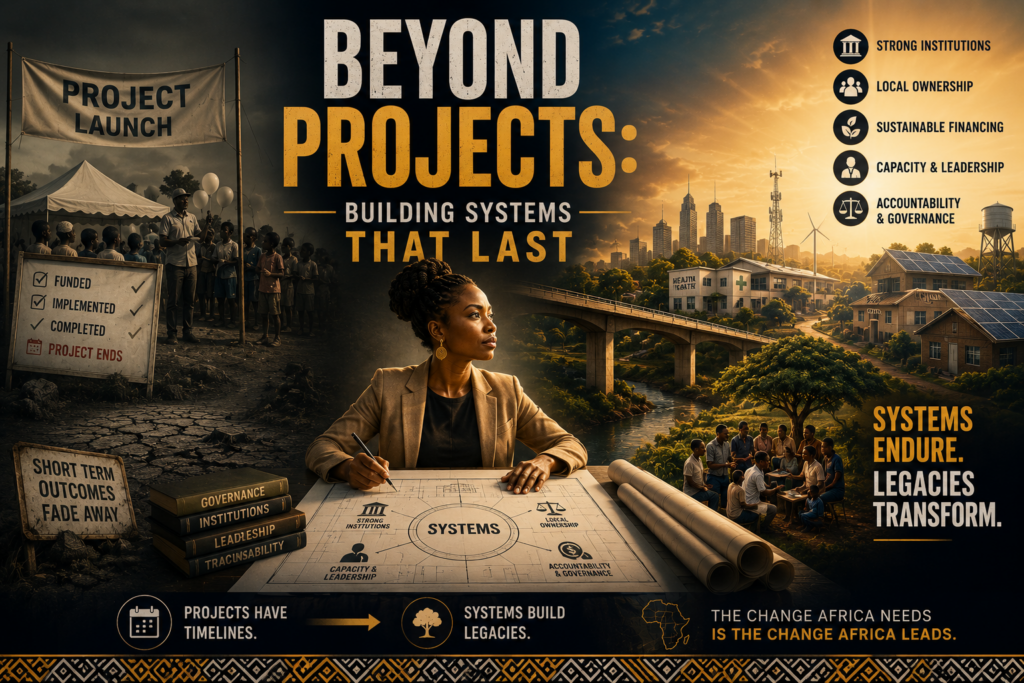
The challenge is that systems are harder to fund, measure, and celebrate. There are no ribbon-cutting ceremonies for stronger governance structures, improved institutional capacity, or sustainable financing mechanisms. Yet these investments often determine whether development sticks or slips.
Africa does not simply need more projects. It needs stronger institutions, better governance systems, and greater local capacity that will sustain progress long after any single programme ends. That’s why the right question is never just “What did we deliver?” it is, “What capacity did we leave behind?”
The SDGs and the Case for African Ownership
The global commitment to the United Nations Sustainable Development Goals (SDGs) provide an important vision for a more just and prosperous world in 2030. However, the SDGs also reinforce a critical truth: sustainable development must be locally driven. In fact, an estimated 65% of SDG targets depend directly on the effectiveness of local and regional governments. Ending poverty, improving health outcomes, expanding education, advancing gender equality, and building climate resilience all require strong local institutions and accountable leadership.
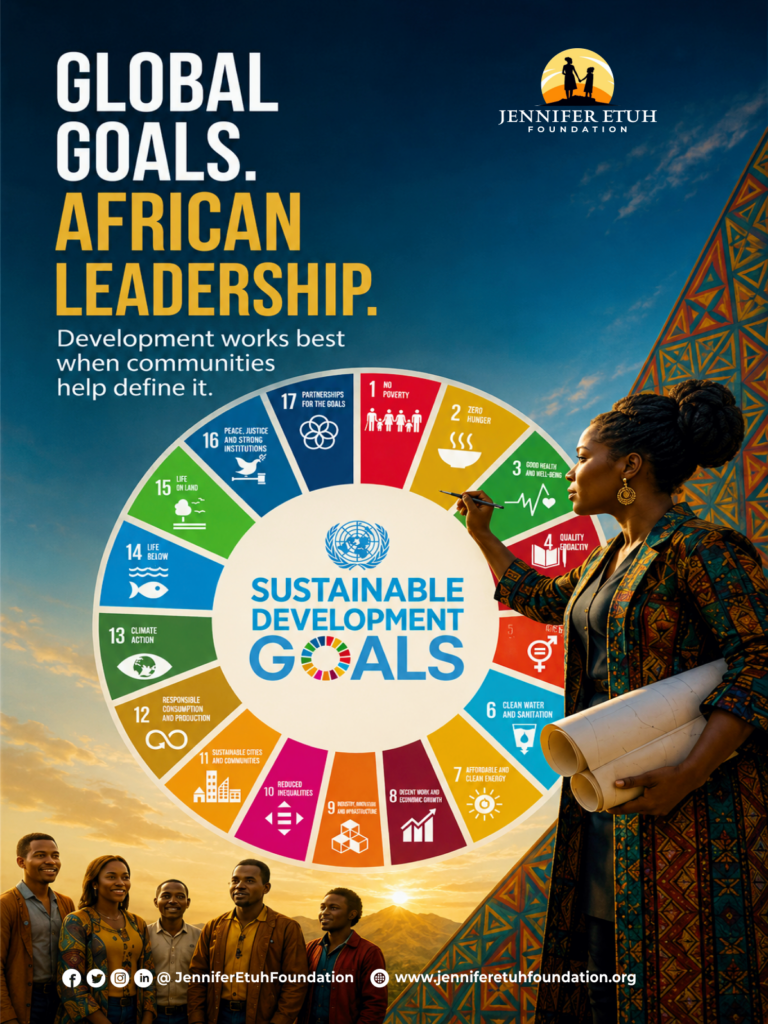
A powerful example is Ethiopia’s Health Extension Programme, which deployed 40,000 community health workers drawn from the communities they served. The programme demonstrated that scale and sustainability are achievable when design is rooted in local realities. It also proved that development works best when communities are not merely beneficiaries but active leaders in the process.
What Genuine, Equitable Partnership Looks Like
Creating a more equitable development system does not require international actors stepping aside; it requires them stepping into a different role. That means providing flexible, long-term funding that helps local organisations strengthen their institutions, not just deliver projects. It means using global influence, networks, and expertise to amplify local leadership rather than overshadow it.
It also means designing programmes collaboratively from the start, with communities helping define both the problem and the solution. Accountability must flow both ways: local organisations accountable to the communities they serve, and international partners accountable for whether their involvement strengthens or weakens local capacity.

Equally important, African governments must lead by setting clear priorities and ensuring external interventions align with national and local development plans rather than operating parallel systems.
Trust, Accountability, and Ethical Governance Are Non-Negotiable
Advocating for African-led development does not mean overlooking the challenges that exist within African institutions. It is about holding African-led development to a “higher” standard, one where ethical governance, community accountability, and transparency aren’t aspirations but non-negotiables.
Communities have suffered not only from poorly designed external programmes but also from corruption, poor governance, and institutional failure closer to home. True African-led development demands more than a change in who sits at the head of the table. It demands a culture of trustworthiness where communities trust institutions, citizens can hold leaders accountable, and donors are confident that local organisations can manage resources responsibly. This is because in development, trust is infrastructure and like all infrastructure, it must be built deliberately, maintained consistently, and protected fiercely.
JEF’s Vision: Development That Belongs to the People
At Jennifer Etuh Foundation, we believe development works best when communities are treated as partners rather than recipients. That’s why our Africa-focused vision is built on a simple conviction: the people closest to the challenges are often closest to the solutions. This conviction shapes how we engage communities, design interventions, build partnerships, and measure impact.
Whether we’re running a free medical outreach in Osun state, a woman’s economic empowerment programme in Kaduna state, or a menstrual health intervention in the Federal Capital Territory, we show up as partners. Our goal is not to create dependency but to strengthen local capacity and agency.
We’ve seen what that looks like in practice. We’ve seen women in Kagoro who didn’t just receive economic empowerment, they became community advocates. We’ve seen girls in Abuja who didn’t just receive menstrual hygiene kits, they became peer educators and changemakers. These outcomes go beyond service delivery; they represent lasting transformation. True development is not measured only by what is provided. It is measured by what communities can sustain and multiply long after an intervention ends.
Africa’s Future Must Be Written by Africans
Africa possesses the talent, creativity, cultural wealth, institutional knowledge, and sheer human potential to author a development story unlike anything the world has seen. The question facing Africa today is not whether development should happen: poverty, health inequities, infrastructure deficit, and the need for investment and collaboration are real. The question is who gets to shape Africa’s development? Will it continue to be driven primarily by external priorities, metrics, and timelines, or will African institutions, leaders, and communities step fully into the leadership role it has always been capable of and demand that the world’s development architecture finally catches up?

One thing is certain: the future of Africa will not be secured by solutions imported from outside it. It will be secured by Africans who refuse to wait for permission to create it.
Join the Movement
If you are a policymaker, donor, development practitioner, faith-based leader, corporate partner, or community advocate, our call is clear:
- support development models that place communities at the centre
- invest in systems, not just projects
- champion accountability and ethical leadership at every level
- trust local expertise and strengthen local institutions
- partner with Africans not merely as implementers, but as architects of their own future
References
1. African Arguments — How Useful Is Aid to Africa?
2. African Development Bank — Human Development: Africa’s Population Growth
3. UNFPA Nigeria — Country Programme Document for Nigeria
4. African Development Bank — Feed Africa Strategy: Uncultivated Arable Land
5. World Bank — Community-Driven Development Overview
6. United Nations — The Sustainable Development Goals
7. Joint SDG Fund — From Global Goals to Local Impact: The Power of SDG Localization
8. WACSI — Why International Development Projects Fail in Africa
9. Mo Ibrahim Foundation — Demystifying Africa’s Dependence on Foreign Aid
10. Foreign Affairs — Africa After Aid
11. Exemplars in Global Health — Ethiopia’s Health Extension Programme