Too often, development is reduced to outputs or the number of projects completed: classrooms built, hospitals renovated, town hall meetings, workshops held, etc. Sometimes it is also evaluated based on the volume of funds disbursed. While these matter, they are not the end goal. The true measure of development is its capacity to restore dignity, strengthen systems, and equip communities to thrive long after external actors exit. That’s why at Jennifer Etuh Foundation (JEF), we are committed to driving transformational development, and transformation always begins with people. Hence our philosophy, ‘People first. Impact always.’
Development Is Not About Projects. It Is About People
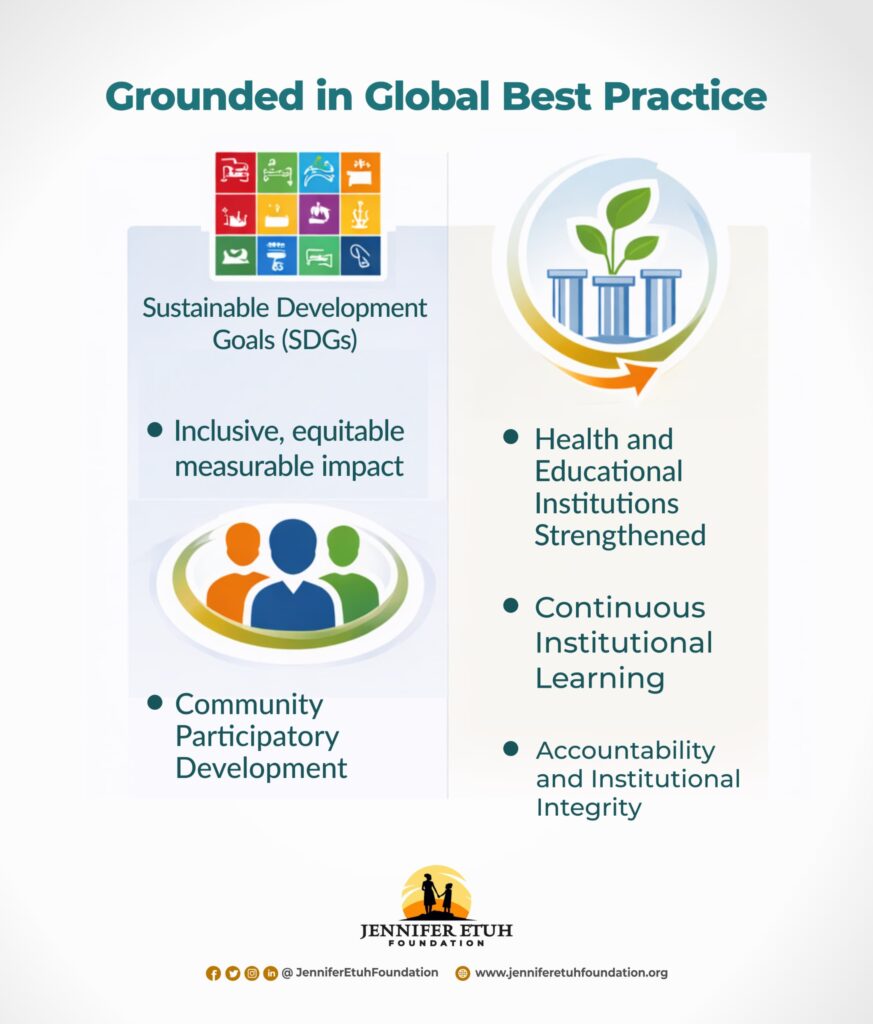
Across the globe, the most effective development frameworks share one common thread: people are not passive recipients; they are central actors. The global commitment to the United Nations Sustainable Development Goals (SDGs) makes this clear. Whether addressing poverty (SDG 1), health (SDG 3), education (SDG 4), or strong institutions (SDG 16), the emphasis is not simply on delivery but on equity, inclusion, resilience, and sustainability.
Similarly, Community-Driven Development (CDD) models championed by the World Bank demonstrate that when communities participate in identifying priorities and managing resources, outcomes are more sustainable, more accountable, and more aligned with real needs.
The evidence is consistent: projects implemented for communities may succeed temporarily because they create dependency, but projects implemented with communities endure because they foster ownership, and ownership is the foundation of sustainability.
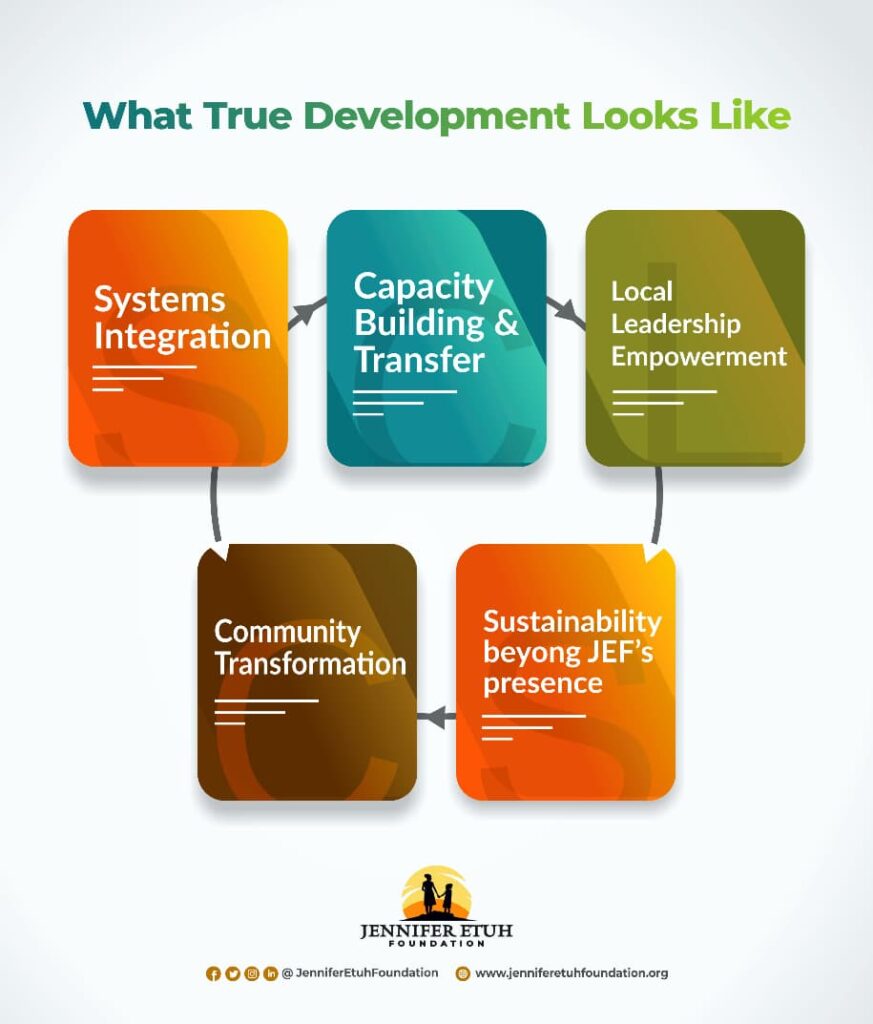
What True Development Looks Like
Development for what it is truly worth reflects global best practices:
- Communities shaping decisions, not just receiving aid
- Local systems strengthened to function independently
- Transparent governance structures put in place
- Measurable outcomes aligned with national and global priorities
- Sustainability designed from the outset
This aligns with SDG 16’s call for strong institutions, SDG 17’s emphasis on partnerships, and the growing global shift toward locally led development. This underscores the fact that development is not charity. It is not short-term relief masquerading as long-term change. It is systems-building, dignity-protecting, and future-focused.
Our People-Centred Development Framework
At JEF, our philosophy is anchored in global best practices yet deeply rooted in local realities. Every intervention begins with one defining question:
“How will this improve lives in a way that lasts?” This conviction shapes a development framework built on three guiding pillars:
1️. People-Centred Design
We begin with listening.
As aforementioned, communities are not passive recipients of aid; they are co-architects of their own transformation. They define the problem, shape the solution, and co-own the outcome. This aligns with globally recognised Participatory Development and Community-Driven Development (CDD) models, where sustainable impact is built from the inside out. A compelling example is the Kaduna Women Economic Empowerment (WEE) Program.
Identifying the Root Challenge
Kaduna state is riddled with a high rate of poverty in numerous communities. Through grassroots research, stakeholder dialogue, and community engagement, we identified two interconnected drivers of poverty:
- Limited access to marketable skills for women
- Poor agricultural yields due to lack of inputs, training, and enabling infrastructure
Rather than impose a pre-designed solution, we co-created one with the communities: the WEE Program.
Designing a Structured, Scalable Intervention
The WEE Program is a 3-year initiative targeting 3,000 beneficiaries:
- 1,800 trained in Vertical Sack Farming
- 1,200 trained in Skills Acquisition
Phase 1 (2024): Jama’a & Kaura LGAs: At the pilot phase,
- 410 women were trained in:
- Tailoring
- Cosmetology
- Hair Dressing
- Bag Making
- Shoe Making
- Catering
- 670 women were also trained in Vertical Sack Farming, cultivating tomatoes, peppers, and other vegetables.
The result? A 97% increase in plant yields by the end of the training cycle, translating directly into improved food security.
Phase 2 (2025): Zaria & Makarfi LGAs witnessed
- 400 beneficiaries trained in skills acquisition (200 per LGA)
- 600 beneficiaries trained in vertical sack farming (300 per LGA)
While women remain our primary target audience, we intentionally included 10% male representation in Phase 2 to strengthen household-level economic stability and community cohesion. The result? A significant increase in household income lifting numerous families toward financial stability.
Beyond Training: Practical Ecosystem Support
Our approach goes beyond the four walls of our training centres. We establish demo farms where beneficiaries learn through structured, hands-on guidance. Participants are equipped with:
- Seeds
- Coco peat
- Pittmoss
- Seeding trays
- Pesticides
- Herbicides
This ensures they do not leave with theory alone; they leave with tools, confidence, and productive capacity. Little wonder that at the second closeout ceremony in December 2025, beneficiaries showcased high-quality finished products and thriving farm outputs.
Phase 3: Scaling Impact
Building on documented success, Phase 3 will extend to Chikun and Kaduna South LGAs, expanding both reach and depth of impact. Our confidence in the program’s longevity rests on one principle: OWNERSHIP. The communities are not just participants; they are stewards of the vision. Even beyond project close-out, replication and peer-to-peer transfer are already underway.
2️. Accountability & Ethical Governance
Trust is the currency of development. Without it, impact cannot scale and partnerships cannot endure. At JEF, accountability is not a compliance exercise; it is a governance system embedded across our operational architecture. In alignment with SDG 16 (Peace, Justice, and Strong Institutions), we institutionalise accountability through four mechanisms:
- Transparent resource management
- Measurable performance indicators
- Continuous monitoring and evaluation
- Ethical stewardship
In light of this, every one of our interventions is tracked not just for outputs (numbers trained) but for outcomes (increased income, improved yields, business continuity) and long-term impact (household stability and community resilience). Our credibility, therefore, is not claimed; it is measured.
3️. Sustainability Beyond JEF’s Presence
The global development sector increasingly recognises a critical truth: short-term projects without systems integration create dependency, so we intentionally design against this risk: each WEE project phase includes a 6-month intensive, hands-on training model, facilitated by experts. But we go further:
- Beneficiaries receive post-training support
- Skills are linked to income pathways
- Knowledge transfer mechanisms are embedded
- Participants are opportune to train and employ others
This multiplier effect ensures that empowerment does not end with one cohort. It spreads, and by equipping individuals with both productive assets and transferable knowledge, we create a ripple effect that strengthens entire families and communities, ensuring that sustainability is guaranteed.
JEF’s End-to-End Development Framework
Our development model is structured across four integrated stages:
1. Design: Evidence-based planning grounded in
* Community needs assessment
* Data analysis
* Policy alignment (national frameworks and SDGs)
* Risk mapping
2. Delivery: Structured implementation featuring:
* Defined milestones
* Local stakeholder integration
* Capacity strengthening
* Asset provision and ecosystem support
3. Evaluation: Impact measurement through
* Output, outcome, and impact tracking
* Financial accountability reviews
* Beneficiary feedback systems
* Independent validation where required
4. Institutionalisation: Where sustainability is embedded through
* Local ownership transfer
* Peer-to-peer replication
* Skills diffusion
* System integration within local economic or health ecosystems
This ensures that programs do not end at close-out, but transition into community-led continuity.
Sustainability Is the True Test
The real test of development is simple: Does it last? This is important because if impact disappears when funding ends, sustainability was never embedded. Sustainability in development, therefore, comes to bear when impact becomes generational. Globally, development partners are shifting toward:
- Domestic capacity strengthening
- Institutional resilience
- Policy alignment
- Long-term financing sustainability
At JEF, we embrace this shift fully and are committed to building systems that:
- Outlive donor cycles
- Outlast political administrations
- Empower communities to lead their own progress.
Our Commitment to Donors and Partners
As an organisation, we understand that development today requires measurable impact, ethical governance, and alignment with global frameworks. As a result, we view every partnership as a shared responsibility to the people we serve. That’s why we commit to:
- Transparency in financial and programmatic reporting
- Alignment with SDG priorities
- Measurable, data-informed outcomes
- Ethical resource stewardship
- Continuous improvement through evaluation
The Bigger Picture
Development across Africa is at a defining moment, and it is undeniably clear that development is not charity; it is dignity restored, systems strengthened, and people empowered to build their own futures. That’s why at JEF, we are not running projects; we are cultivating ownership, accountability, and generational impact. This is what makes the difference, and this is what creates long-lasting impact.
Join Us
If you are a donor, partner, policymaker, or development professional who believes that development must be people-centred, accountable, and sustainable, we invite you to partner with us. Let’s build solutions that outlast us. Let’s strengthen systems that sustain communities. Let’s move beyond projects and pursue true impact.
Connect with us today.