Real development is a partnership with people, and nation-building begins when dignity is restored, systems are strengthened, and hope is made practical. This is the belief that shapes every of our outreaches including our first outreach of the year in Odu-Ogboyaga, Kogi State.
Rethinking What Impact Really Means
We are aware that life in underserved communities is rarely one-dimensional. As a matter of fact, poverty, illness, and spiritual fatigue often walk hand in hand. That’s why our outreach in Odu-Ogboyaga and its environs followed three coordinated streams:
• Widows’ Outreach: Providing economic and social support for widows, many of whom shoulder responsibility without recognition or safety nets.
• Medical Outreach: Providing access to free, quality healthcare, for families disadvantaged by cost rather than choice.
• Evangelical Outreach: Providing spiritual engagement, hope, meaning, and direction.
Together, these pillars formed a formidable framework—human-centred, scalable, and sustainable development.
Why Widows Matter in the Development Conversation
Widows are often discussed in humanitarian terms, but rarely in developmental terms. Yet they sit at the intersection of vulnerability and resilience—holding families together, sustaining households, and shaping community values. Having this consciousness, JEF organised a special outreach for widows on January 24th, 2026.
At the outreach, JEF supported 1,200 widows with thoughtfully curated gift packs containing food items, clothing, and cash. But the real intervention was deeper: it was the gift of recognition. It was an acknowledgement of the fact that when widows are empowered, household stability improves. When households stabilize, communities gain traction. And when communities gain traction, the nation develops. In essence, supporting widows is not charity—it is social investment.
Healthcare as an Economic Infrastructure and a Development Strategy
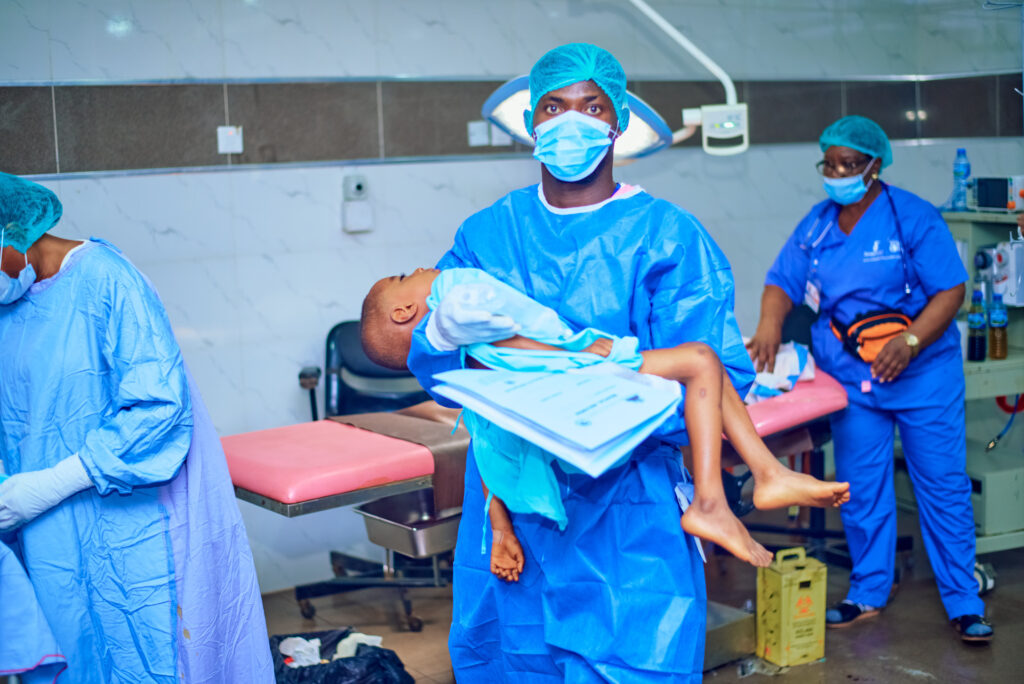
From January 26th to 30th, the Jennifer Etuh Medical Centre became a health hub—patients arriving early, families waiting patiently, healthcare professionals working tirelessly with intention and precision.
Over five days:
• 3,805 patients were attended to and
• 10,097 medical interventions were delivered
But behind every intervention was a deeper reality: untreated illnesses especially preventable ones erode productivity, deplete household income, and limit community development. This proves that healthcare is more than a welfare issue, it is economic infrastructure. That’s why providing free medical care isn’t just compassionate—it is economically strategic because a healthier population is a more productive one. This is how healthcare strengthens national capacity and facilitates nation building.
A Promise That Became Policy
Healthcare sits at the heart of JEF’s mission for a reason.
Late Mrs. Jennifer Ramatu Etuh left a clear instruction before she died: “No woman or girl should suffer the way I did.”
Her response was visionary and strategic: six state-of-the-art medical centres built across Nigeria’s six geopolitical zones. Facilities designed to decentralise access to quality healthcare and correct structural inequality. The Odu-Ogboyaga outreach was in effect not an isolated gesture. It was continuity; a promise translated into policy and compassion scaled for impact.
Why Spiritual Health Is Not Optional
Development conversations often sidestep spirituality, yet values, purpose, and moral orientation shape how societies function. Mrs. Etuh believed that a nation’s health is incomplete without spiritual wholeness. It is for this reason that throughout the medical outreach, patients were afforded the opportunity to encounter faith in a personal way and 779 individuals chose to begin a personal relationship with Christ.
This mattered because sustainable development is not only about longevity of life, but in quality and direction of living. So, as bodies were treated, spiritual restoration was also taking place; healing, after all, is most powerful when it reaches the deepest places.
Our Biggest Takeaway from Odu-Ogboyaga
At the conclusion of the outreach, what Odu-Ogboyaga revealed is simple yet unsettling: communities do not lack resilience; they lack access:
● Access to quality healthcare.
● Access to support systems.
● Access to hope that is practical and enduring.
While we left with a deep sense of fulfilment at the impact made, this revelation left us with a shared sense of responsibility and a resolve to continue to close this gap with sustainable frameworks. This is the gift that Jennifer’s legacy gives us as six years after her demise: her compassion did not end as memory, it has become a living language spoken through service, healing, dignity, and hope. That’s why as long as there are communities in need, we will keep showing up intentionally, consistently, and purposefully, providing development that builds people, strengthens communities, and nudges a nation closer to the future it deserves, one life at a time.